


Managing Non-Human Identities, Secrets & Bots
Non‑human identities (NHIs), service accounts, CI/CD runners, containers, and integrations need secrets (API keys, tokens, passwords, certificates) to authenticate to systems. When those secrets are hardcoded, shared across environments, or rarely rotated, a single leak can become an incident.

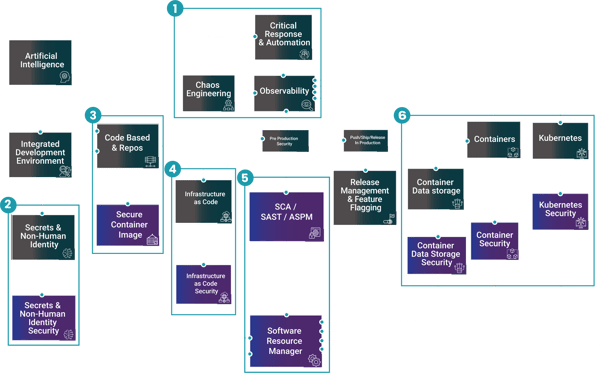
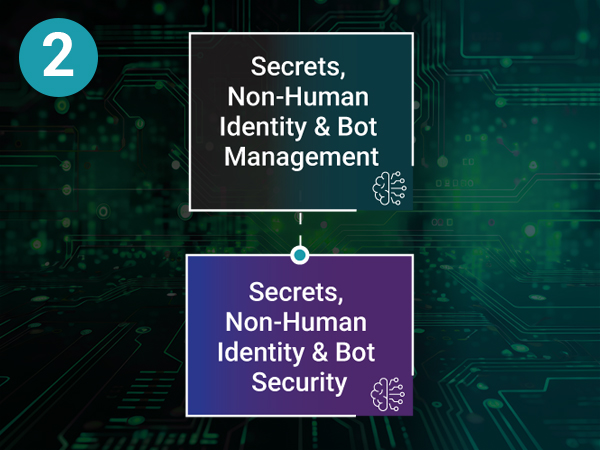
Secrets, Non-Human Identity, Bot Management and Security
Modern applications rely on APIs, automation, and bots, but secrets like API keys and passwords are often exposed in code or pipelines. At the same time, bot traffic can drive fraud, abuse, and outages while teams struggle to distinguish legitimate bots from malicious ones.
The solution secrets and non-human identity security solves this by securely storing, accessing, and rotating credentials, and by detecting and controlling bot behaviour so only trusted identities and bots can access critical systems.
Secrets and Non-human Identity
Problems
API’s and Passwords exposed in code
Solution
Safely storing and accessing sensitive information like API keys or passwords.
Together...
Modern applications rely on non-human identities service accounts, API keys/tokens, certificates, and automation scripts/bots to move data between systems and run CI/CD. When secrets are hard-coded, shared, or long lived, they can leak through repositories and pipelines and become difficult to audit and rotate. At the same time, automated traffic hits every digital channel: some bots are legitimate, while others scrape data, create fake accounts, attempt account takeover, or abuse transactions so teams need a way to separate “good” bots from malicious automation.
Managing and securing secrets, non-human identity and bots brings these risks under control with complementary capabilities.
GitGuardian detects exposed credentials in source control and DevOps tooling so teams can revoke and remediate early.
Akeyless centralises secrets across cloud and Kubernetes with governance, automated rotation, and just-in-time access to reduce standing privileges.
HUMAN Security adds bot detection and mitigation for sites, apps, and APIs, giving visibility and control over known bots and AI traffic.
Together, partners can help customers reduce credential exposure, tighten machine access, and protect digital experiences without slowing delivery.
Industry Awards


It’s estimated that Non-Human entities already outnumber Human Entities by 50:1, a number that is pushing towards 100:1. In these scenarios, around 40% of them have no owner and an even higher 80% of them have security postures that are vulnerable to attack. Companies are under pressure to address this with many of them unable to accurately see all their own NHI inventory.
Companies with 50+ developers, that lean into automation technologies and that are in highly regulated industries are at the biggest risk.
Roles
Who cares about Managing Non‑Human Identities, Secrets & Bots?
CISO/Head of Security
Security Engineering Lead
Cloud Security Architect
DevOps/DevSecOps Lead
Platform Engineering Manager
Developer Platform Owner
AppSec Lead/Product Security
IAM/Identity & Access Management Lead
SOC/Incident Response Lead
Fraud/Abuse/Trust & Safety Lead
Engineering Manager
Head of Engineering
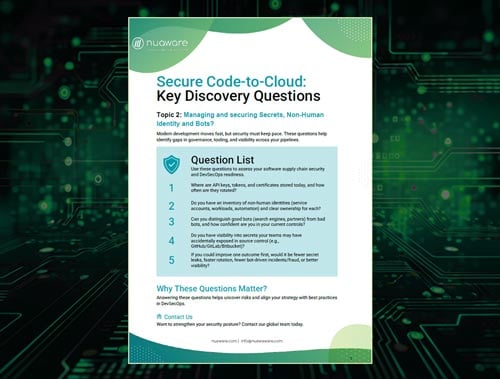
Key Discovery Questions
|
1 |
Where are API keys, tokens, and certificates stored today, and how often are they rotated? |
|
2 |
Do you have an inventory of non‑human identities (service accounts, workloads, automation) and clear ownership for each? |
|
3 |
Can you distinguish good bots (search engines, partners) from bad bots, and how confident are you in your current controls? |
|
4 |
Do you have visibility into secrets your teams may have accidentally exposed in source control (e.g., GitHub/GitLab/Bitbucket)? |
|
5 |
If you could improve one outcome first, would it be fewer secret leaks, faster rotation, fewer bot-driven incidents/fraud, or better visibility? |

Continue Your Journey
Contact Us
Connect with our global team
As technology continues to reshape industries and deliver meaningful change in individuals’ lives, we are evolving our business and brand as a global IT services leader.