
Govern who — and what — ships your code
Every identity operating in your SDLC — human, non-human, and AI — discovered, governed, and audit-ready. BlueFlag Security is the Developer Risk & Governance Platform for the AI-driven SDLC.


Looking for the leading SDLC Developer Risk & Governance Platform?
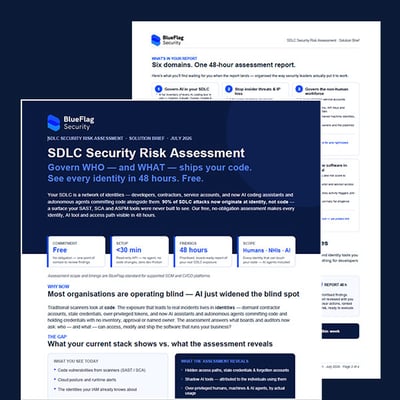
BlueFlag Security helps organisations secure and govern the people, machines and AI agents that build their software. While traditional AppSec tools scan code, 90% of SDLC attacks now originate at identity — not in code: developer credentials, service accounts, stale tokens and, increasingly, AI coding agents. BlueFlag discovers every identity across the development toolchain, builds behavioural baselines, surfaces risk with full identity context, and enforces policy in real time — turning every SDLC blind spot into a tracked, attributable, board-defensible signal.
Founded by security veterans from Microsoft, CloudKnox, VMware and Symantec, BlueFlag is recognised as an IDC Innovator for SDLC Identity & Access and featured across Gartner Hype Cycles for Application Security, Agile & DevOps and Platform Engineering — and is trusted by global enterprises including Medallia, Greenlight and Western Union.
BlueFlag Security Solution Portfolio
Identity-centric risk, built on context
One platform that unifies identity, behaviour, tools, code and compliance across the software factory. BlueFlag's Activity Intelligence Graph correlates every developer, non-human identity and AI agent with every commit, pull request and pipeline run across 60+ development tools — ML-driven baselining that catches insider risk, credential abuse, toxic permission combinations and AI anomalies before damage, not after.
Every AI agent is an identity. Govern it like one
Copilot, Claude, Cursor, Codex — AI agents are already writing, reviewing and merging code. BlueFlag treats every AI coding tool as a first-class, governed identity:
- Visibility — auto-discover every AI tool in use, including shadow AI; classify sanctioned vs. unsanctioned.
- Provenance — see where AI-written code enters your codebase and what ships to production; defensible code provenance for IP ownership, audit and M&s;A diligence.
- Risk intelligence — behavioural baselines and anomaly detection per agent; least-privilege enforcement and drift remediation.
- Policy enforcement — build-your-own policies in natural language; block unapproved AI tools and produce audit evidence automatically.
How BlueFlag works
From connect to remediate in four steps — deployed alongside your stack, not inside it:
- Connect — pre-built API integrations with 60+ SCM, CI/CD, IAM, registry and SIEM tools (GitHub, GitLab, Azure DevOps, Jenkins, Okta, JFrog, Splunk and more). No agent. No code changes. Deployed in minutes.
- Discover — continuously inventory every developer — human, non-human and AI agent — and every dev-tool activity; build the Identity Graph with behavioural baselines.
- Detect — surface risky behaviour, over-privilege, toolchain misconfigurations, AI anomalies and code-provenance gaps with full identity context.
- Remediate — enforce policy in real time: right-size access, harden SDLC posture, and generate continuous, audit-ready compliance evidence mapped to NIST SSDF, ISO 27001 and SOC 2.
Why use BlueFlag Security
![]()
Close the identity gap: your existing SAST, SCA and ASPM stack scans code — BlueFlag governs the identity layer where 90% of SDLC attacks actually begin.
Govern the AI-driven SDLC without slowing developers — agentless, tool-agnostic and invisible to engineering workflows.
Catch insider threats, credential abuse and IP leakage early — traced to the specific identity, not just a finding.
Put the non-human workforce under IAM discipline: service accounts, bots and tokens that outnumber humans 10–50×.
Turn weeks of audit preparation into automated, on-demand reports — customers report up to 80% less manual work, 45% tool cost savings and 40% faster remediation.
BlueFlag Top Customer Use Cases
Four use cases where security leaders realise value with BlueFlag first — each backed by a dedicated solution brief available through Nuaware.
1. Agentic AI — govern the agents, and the economics
AI agents are already committing, reviewing and merging code — Copilot, Claude, Cursor, Code-Rabbit, Qodo, Lovable and more. BlueFlag's AI Insights answers the risk question (which agents can change our software, with what privileges?) and the economics question (what does the spend and token burn actually return in accepted code?) from one place: every agent discovered and governed as a first-class identity with an OverPrivilege Score, Shadow-AI surfaced before it ships code unseen, an AI-BOM per repository, and every dollar of AI spend traced through tokens to accepted code — the unit economics of AI coding, per tool and per team.
Ideal customer profile:
Organisations scaling AI coding tools across engineering, where the CISO (risk), CFO (cost) and CTO (velocity) are asking questions today’s tooling cannot answer.
2. Intellectual Property Protection — from source code to fiduciary duty
External developers, contractors, offshore teams and AI coding agents now contribute a growing share of enterprise software — and under §93 AktG, the EU Trade Secrets Directive, NIS2 and equivalent corporate-governance law, protecting software IP has become a board-level legal duty. Traditional controls (NDAs, contracts, DLP, escrow) define ownership on paper; BlueFlag shows who can actually access, modify, copy or expose the code — across employees, contractors, machine identities and AI agents — with the “reasonable steps” evidence trade-secret protection now requires, exportable for audits and M&A due diligence.
Ideal customer profile:
European enterprises whose value is carried by proprietary software and algorithms, with external or offshore development — and boards, GCs or PE investors asking for proof of IP governance.
3. EU Cyber Resilience Act — the proof lives in your SDLC
The CRA makes manufacturers of every product with digital elements prove secure development: access control, activity logging, SBOM due diligence, vulnerability handling, 24-hour reporting (from 11 September 2026) and ten-year documentation, with full application on 11 December 2027. Scanners and SBOM generators cover the artifact layer; BlueFlag is the system of record for the missing development-evidence layer: who — human, bot or AI agent — wrote, approved and shipped each component, whether access was actually controlled, and vulnerability-to-commit-to-owner tracing in minutes when the Article 14 clocks start.
Ideal customer profile:
Manufacturers CE-marking hardware or software for the EU market — industrial, automotive, medical, telecom and software vendors preparing for September 2026 reporting and December 2027 conformity.
4. Prevent vulnerabilities at the source — from detection to prevention
In BlueFlag telemetry, 10–15% of development teams introduce 85–90% of new vulnerabilities — via open-source choices, AI-generated code (45% of which fails security tests) and risky workflows. SAST, DAST, SCA and ASPM find flaws after the code exists; BlueFlag complements them at the prevention layer: governing the identities, AI agents, dependency choices and workflows that create the risk — with policy enforced at commit time, the high-risk cohort governed before code ships, and customers reporting 80% less manual work, 45% tool cost savings and 40% faster remediation.
Ideal customer profile:
Mature AppSec organisations with an established scanner estate, drowning in findings and looking for the upstream control layer that reduces what gets created — not another detector.
BlueFlag Achievements
IDC Innovator: Software Development Life-Cycle Identity and Access, 2024 — one of only three vendors included. Announcement:
Gartner Hype Cycles — featured across the Hype Cycles for Application Security, Agile & DevOps, and Platform Engineering.
ESG Technical Validation — “How BlueFlag Security Prevents, Detects, and Remediates SDLC Risks”
Typical customer environment
Enterprise software factories with hundreds of developers, contractors and offshore teams; service accounts, bots and tokens outnumbering humans 10–50×; AI coding tools scaling across engineering; a scanner estate (SAST/SCA/ASPM) already in place but no governance of the identity layer. Read-only, agentless deployment delivers first findings within 48 hours.
Per-use-case qualifying questions
![]()
Agentic AI: Can an unregistered AI agent merge to production — today? Do you pay for seats nobody uses while unlicensed tools burn tokens? What did that feature actually cost in AI spend?
IP Protection: Which external developers can reach your code — right now? Was contractor access removed after the last project ended? Could you prove “reasonable steps” to a court or an acquirer?
EU CRA: Can you prove who built each component of your product? Do the Annex I activity logs exist — for every release? Could you trace an exploited CVE to commit and owner within the 24/72-hour windows?
Prevention at source: Do you know which 10–15% of your teams create most of your new findings? Is AI-generated code entering production without provenance? How many weeks does audit evidence take today?
BlueFlag CISO Executive Discovery — ten questions to open the conversation
For Nuaware partners and sellers, any single “no” or “not sure” is the entry point for a BlueFlag discovery scan.
What is your biggest concern around software delivery risk today?
Do you have visibility into who or what can change production systems?
What is your biggest concern around software delivery risk today?
Do you have visibility into who or what can change production systems?
What is your biggest concern around software delivery risk today?
Do you have visibility into who or what can change production systems?