
Artificial Intelligence for DevSecOps
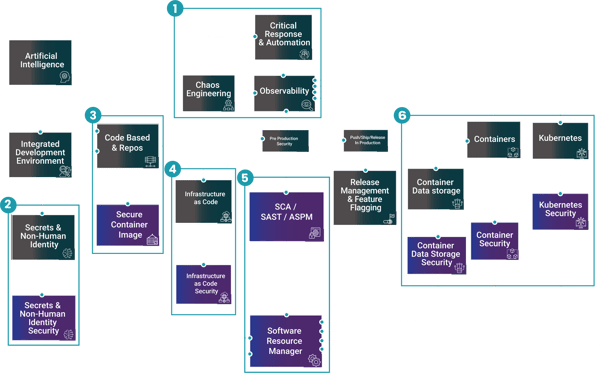
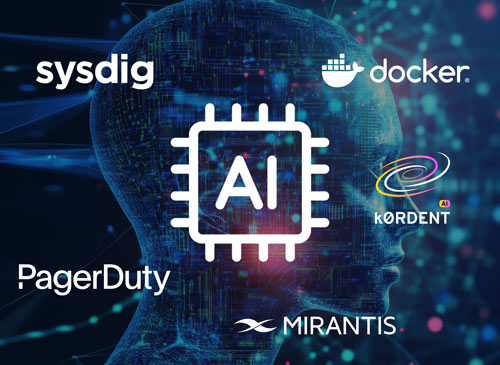
AI is moving from experimentation to practical DevSecOps acceleration. Used well, it helps teams identify, prioritise, and remediate risk earlier without slowing delivery.
Teams can also use AI to automate triage by grouping findings, assigning ownership, and highlighting what is most likely to impact production.

Artificial Intelligence
Problems
High Development Costs.
Solution
Utilises compute power to generate responses based on inputted requests or actions.
Artificial Intelligence
Developing software is getting more expensive as teams juggle faster delivery cycles, security requirements, and increasing operational complexity. Many organisations lack the time and specialist skills to keep up.
The solution AI solves this by using trained models and scalable compute to assist with coding, testing, documentation, and security tasks generating suggestions and responses from prompts and context so teams can ship faster, reduce rework, and improve quality without adding headcount.
In the pipeline, AI can review code changes for risky patterns, suggest secure by default configurations, and help generate policy as code or IaC guardrails.
In security operations, it can correlate findings from scanners, CI/CD logs, runtime signals, and cloud controls to reduce noise and surface the few issues that truly block a release.
For developers, copilots and chat based workflows can turn security guidance into actionable fixes explaining impact, proposing a patch, and creating the right ticket context.
The key is governance: define where AI is allowed to act, keep humans in the loop for approvals, protect sensitive code and secrets, and measure outcomes like false positive reduction and mean time to remediate. Done right, AI becomes a force multiplier across build, deploy, and run.

All industries have Generative AI initiatives across various parts of their business & it’s openly predicted that the US market alone is set for a 40.6% CAGR rate from $25B to $280B over the next few years. The US only representing 40% of the overall Generative AI market. For Nuaware, we’re seeing this in several parts of their DevSecOps chain – GenAI, AIOps, AgenticAI for your LLM’s, AI powered Infrastructure as Code & of course, AIOps – all of which are projects that cover everyone from Developer to Engineering, Compliance and Operations teams.
Financial Services/FinTech
Insurance
Healthcare
Public Sector
Telecommunications
Energy
Retail/Ecommerce
Technology/SaaS/ISVs
Transportation/Logistics
Roles
Who cares about AI for DevSecOps?
Platform Engineering Manager
Developer Platform Owner
DevOps/DevSecOps Lead
Application Security (AppSec) Lead
Product Security
Security Engineering Lead
Cloud Security Architect
CISO/Head of Security
SRE/Operations Lead
Head of Engineering
Engineering Managers
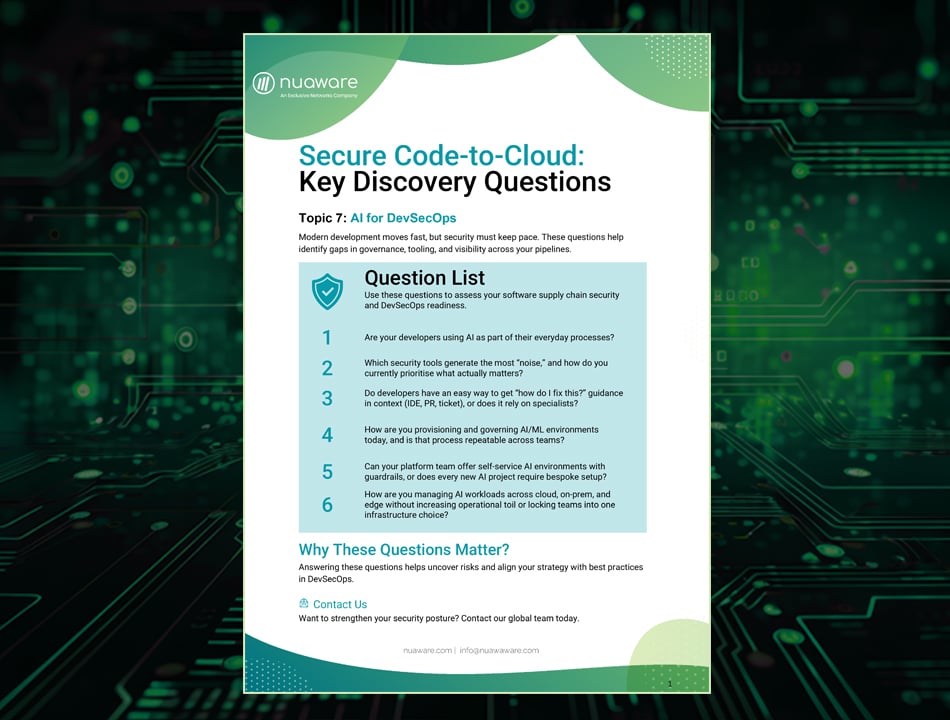
Key Discovery Questions
Answering these questions helps uncover risks and align your strategy with best practices in AI for DevSecOps.
|
1 |
Are your developers using AI as part of their everyday processes? |
|
2 |
Which security tools generate the most “noise,” and how do you currently prioritise what actually matters? |
|
3 |
Do developers have an easy way to get “how do I fix this?” guidance in context (IDE, PR, ticket), or does it rely on specialists? |
|
4 |
What AI tooling (if any) is already in use for engineering, and do you have policies on what data/code can be shared with AI? |
|
5 |
If you could improve one metric with AI in the next 90 days, would it be fewer false positives, faster triage, faster fixes, or fewer production incidents? |

Continue Your Journey
Contact Us
Connect with our global team
As technology continues to reshape industries and deliver meaningful change in individuals’ lives, we are evolving our business and brand as a global IT services leader.